
The Crown Interview
In an era when reading has become an abandoned concept, especially among younger generations and, particularly, within the subculture itself (absurdly so, unfortunately), you come across something like this. You come across an interview that probably only a few people (those who still read) will actually read. But that doesn’t disappoint me; on the contrary, it gives me even more motivation. In an era in which metal, among other things, is losing its edge, its sensitivity, its integrity, its attitude, and even its sense of struggle, I am especially pleased to say that what we have in front of us is not simply a great interview, but a great story, a great, warm conversation. And that is precisely what gives weight to the event taking place in Skopje on September 19. I had a great, friendly conversation with Marko (Tervonen, The Crown’s guitarist), which I didn’t expect would turn into such a great interview, because I knew they were on tour and assumed they wouldn’t have time for an extensive interview. And I was wrong. In an informal conversation with Marko after the interview, he told me that although The Crown’s story is coming to an end, his own story continues. Marko has a studio, as well as several other musical projects. And since he is an exceptional person, I suggested that once the tour is over, we do another interview in which we can talk about the things he will be pursuing after The Crown comes to an end. I wish them all the best in the stories they have yet to tell, and I wish you an enjoyable read. Of course, to those of you who still read...
1. What’s going on with The Crown at the moment?
Things are good with The Crown at the moment. You could say that we’re now at the very end of our farewell tour around the world, and the finish line is getting closer and closer. We still have some exciting countries ahead of us. We’re only a few days away from heading to Poland, where we’ll play our final show there, and then the following weekend we have a double bill where we’ll be playing in Serbia and Macedonia for the first and last time. So there are still quite a few exciting countries left to tick off before we finally wrap everything up in Gothenburg, Sweden, on December 19th. It’s definitely a mixture of emotions all the way through.
2. As announced, No Tomorrow - Farewell 2026 is your final tour. Consequently, this marks the end of a 28-year era. How did it all come to this?
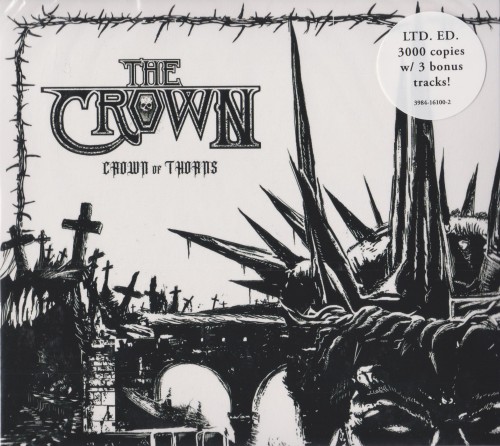
Actually, it’s really the end of a 36-year journey. You may have started counting from Hell Is Here, but we also released The Burning and Eternal Death, originally under the name Crown of Thorns. They have since been re-released as The Crown albums as well. So either way, it’s the end of a very, very long era. As for how we got to this point, I guess you could say it was a case of many small things adding up. But somewhere along the way, while we were working on the final album, Crown of Thorns, I started to get this feeling that it might actually be our last record. That made it incredibly important to make the album as good as possible, to really empty the tank, so to speak. To get all our ideas out there and pour everything we had, all of our death metal, into that record. But it also started to bring some thoughts to the surface that might sound a little naive, but you eventually realize that sooner or later, this is going to end. And that raises a simple question: if it’s going to end, how do you want it to end? Do we just keep going until we become completely irrelevant and nobody cares anymore? Or do we actually have the courage to do something unique and dare to stop while we’re still at our best? Because I think Crown of Thorns is a very, very strong album, and it shows just how strong we still are after more than 30 years. So I think it’s a great ending to a very, very long journey. And as I said, it takes a certain amount of courage to make that decision. Because you’re always thinking, “One more album. One more album. One more album.” And suddenly you’re 60 years old, wondering how long you’re supposed to keep doing this. And what actually makes sense from a metal perspective? We’re 50 now, those of us who are the oldest members of the band, and I think that’s a respectable age, especially considering that we started when we were 14. So it’s been a very long journey. I respect that, and I’m proud of it. But it was time to take control of the ending and make sure that it ends with dignity.
3. Considering the latest album Crown of Thorns was released in 2024 and the current tour is the final one, why not record a farewell album?
Well, Crown of Thorns is a farewell album in a way, because I was pretty sure while we were making it that it was going to be the last one. So it was written with that in mind. That’s also why I went completely all in with the songwriting. I wrote probably 16 or 17 songs, which were then narrowed down to the absolute strongest nine or ten. Mattias also contributed two songs. So there was a tremendous amount of work that went into it, and I just wanted to feel that if this was going to be the last album, we should be damn proud of it. As for recording yet another farewell album, I don’t know. If I’m being completely honest, there was a little voice in the back of my head worrying that we might not be able to top Crown of Thorns. But I know myself, too. That’s actually a feeling I’ve had after every album: “How the hell are we going to top this? We’re on fire here!” So it’s nothing completely new. But no, Crown of Thorns is the farewell album, and I think it turned out to be such a good one, also considering the album title. It points all the way back to our beginnings as a band, when we were called Crown of Thorns. I also really like the artwork and the way we put the whole visual side together. The cover actually represents a famous bridge from our hometown of Trollhättan, which we basically death-metalized a little bit. So in a way, it feels like bringing everything back home. And for me, it’s a perfect final album.
4. Thomas Lindberg was an important part of the band’s history. What did he mean to The Crown, and how do you look back on that period?
Haha. I don’t think we’ve quite had the kind of revolving door you’re describing, but absolutely, we’ve had a few guests over the years, and of course there have been some lineup changes. But simply put, Tomas Lindberg was someone we looked up to enormously. There are some pretty funny stories from when we were younger, before we had ever met him. We were already huge fans of the old Grotesque. The Incantation EP was probably playing nonstop every weekend when we got together, drank beer and worshipped metal. There’s actually a funny story about how we found out that Tompa was working in a record store in Gothenburg called Dolores Records. So we decided to go there and basically pretend to browse through records, just so we could see him. Because he was always a very mysterious figure in the scene. He wasn’t really the standard guy writing lyrics about murder, death and killing. His lyrics were very poetic, and he had a very unusual angle on death metal. So to us, he was almost like a mysterious Gandalf somewhere out on the horizon. It’s pretty funny when you then fast-forward a few years and suddenly he’s in our band and we’re working on Crown in Terror. That was fantastic. We had a really great collaboration on that album. He contributed lyrics, ideas and all sorts of things, and then we went on tour together afterwards as well. Later on, we went our separate ways because, for various reasons, we didn’t really work together that well. But I think everyone in the scene has the utmost respect for Tomas and everything he contributed. And when I hear all the stories afterwards from the Gothenburg bands that practically grew up with him, I’ve always understood that he really was like a father figure to all of them. We’re a little outside Gothenburg, about an hour away, and that might not sound like much, but back then it was almost like another planet. But he was a fantastic person who left us far, far too early.
5. Will you be playing songs from Crown in Terror on the farewell tour, or perhaps any songs connected to Tomas or At The Gates?
Absolutely. Crown in Terror is part of our past, and it’s a strong album. We’ve always enjoyed playing songs from it, and we still do. We’re not doing any At The Gates covers, though. I’ve noticed that other bands are doing that, but for us, it feels more appropriate to play the songs that Tomas actually helped create with us. And of course, we’ll be doing that all the way through to our final show. I see no reason not to play those songs. It’s a combination of strong songs and some pretty strong emotions, considering Tomas’ involvement with them.
6. What is the lyrical background of Crown of Thorns?
It continues in much the same vein as the way we’ve been working for the last 10 to 15 years. There isn’t just one person writing all the lyrics. It’s a combination of several people. In this case, most of the lyrics were written by Johan. I wrote some of them, and even Micke contributed a lyric. So that’s basically how we work. We’ve talked about it several times, maybe we should actually make a proper concept album, where we plan everything from beginning to end and really tie the whole thing together. But it’s never really come naturally to us to work that way. Usually, it’s more of a journey where you focus on one song at a time and try to find lyrics that connect with the music. Sometimes it’s pretty obvious that a super-brutal song needs a more brutal edge to the lyrics. If the song is more melancholic, like Gone to Hell, then the lyrics need to be written in a way that syncs with the music. And in the case of Gone to Hell, it became a little more personal. I wrote that lyric myself. So that’s basically how we function. In the end, we try to tie everything together with the album title, the artwork and so on. But most of the time, I’d say the lyrics are more like individual journeys.
7. There is often a tension between nihilism and the life-affirming intensity in your music. If everything ends in death, what gives life meaning?
That’s probably a question we couldn’t really do justice to in a few minutes. Obviously, that’s one of the biggest questions in human existence: what actually gives life meaning? But in short, I think there are obviously individual ideas about what you want to get out of your life, hopefully over the course of 70 or 80 years. But then there’s the bigger picture, the meaning of life beyond our own individual time, and how our existence fits into the grand scheme of things. And then you can bring the whole cosmos into it as well, which is a huge area of personal interest for me. I love astronomy, and I love following the development of the cosmos. But no, it’s certainly not an easy question with an easy answer. If I had to give one answer, though, I’d probably say that connection, the things that bind us all together, could be a big part of the answer. And I don’t necessarily mean just human beings, but all forms of life. That sense of connection, and strengthening each other, could be a very important part of what gives life meaning snd purpose.
8. Your imagery can be extremely provocative, as in Total Satan, Under the Whip and Death Metal Holocaust. Does that kind of provocation still challenge people, or has society become too desensitized?
That’s a really good question. And then you have to ask yourself: does this stuff still provoke me at 50 in the same way it did when I was 20? Those are two completely different things. As you say, people are totally desensitized today. And I think the desire to provoke, at least for me, just isn’t there anymore. I have nothing to prove. I don’t need to provoke people to somehow prove that I’m weird or different. I know exactly who I am. I’m very comfortable with myself. But basically, some types of lyrics and certain styles just come with the music. It would be almost like asking a blues band, “Why don’t you write any happy lyrics?” Well, because then it wouldn’t be blues. Death metal is death metal in a certain way, and sometimes you have to dig into yourself to capture those more extreme subjects. Personally, though, I don’t find it particularly inspiring anymore to just write straight-up murder, death and kill lyrics. There has to be a little more thought behind them, whether it’s a story, some kind of reflection, or something else. There always has to be more to it than just a slasher template. And I think we’ve had a pretty cool combination of those things over the years. Sometimes you see a song title and your first reaction is, “Yeah, yeah, I know what kind of lyric this is going to be.” But it’s usually not that simple. Magnus was very, very good at twisting things around and giving them more substance. When you think a song is about something as simple as Total Satan, there might actually be something deeper behind the lyrics, perhaps more about freedom and being able to live your life on your own terms.

9. Death Is Not Dead could almost be a statement about The Crown itself. After breakups, reunions, lineup changes and decades of existence, what is it that never dies?
I actually think that was exactly the idea behind it. Death Is Not Dead refers to the fact that the strong death metal foundation that’s embedded in our DNA is never going to die. Obviously, it can change its shape, its expression and so on, but those roots in death metal are incredibly strong within us. I’d almost go as far as saying that the entire ’90s scene created a huge part of my personality and my attitude.
10. You have resisted being placed into a precise Swedish death metal framework. Has that been an artistic freedom, or has it also been a limitation?
That’s another good question. And it’s something that has changed a little bit over the years. After all, we’ve been doing this for 36 years. If you look at it in a simple way, in the early years it’s very common to be strongly inspired and influenced by your heroes. You want to copy them in some way. You want to achieve the same thing, the same effect, that you got from your heroes or their music. For us, that meant a lot of Florida death metal and then Swedish death metal. Swedish melodic death metal in particular was a huge influence on me. But as the years go by, you become more comfortable with yourself, and basically you just want to make the kind of music that feels right in your gut. This feels good. This feels right. We’ve never really had the drive to please people. It’s not like we scan the scene and ask, “What do people need? What do people want to hear now?” We’ve been a little selfish in that sense. If we find a cool angle for a song that doesn’t really follow the usual death metal framework, we’ve never hesitated to make that kind of song. And that’s both a good thing and a bad thing. I know that one disadvantage for us over the years has been that people haven’t really been able to put us into a box. We haven’t sounded like the typical Gothenburg band or the typical Stockholm Swedish death metal band. We’ve been somewhere in between, trying to find our own path. And that’s absolutely nothing I regret, because from my perspective, it’s the only way I can feel creatively free. I want to be able to create the music that comes out of me, and then we as a band shape it into whatever it becomes. That has to be the starting point for me. I can’t force another Deathexplosion or another similar song out of myself. I constantly need to find new paths that feel inspiring. And I think we’ve managed to do that throughout all these years. Of course, it gets harder and harder with every album. But it has always been my starting point not to repeat myself, and I always want to contribute something that’s a little outside the framework.
11. The Crown has always had an element of controlled chaos. How much conflict does art need, and can too much harmony weaken creativity?
Basically, the only real conflicts, or whatever you want to call them, that come up are around a very simple question whenever there’s a new song: is it good or is it bad? You might think that’s a simple question, but ultimately the music has to resonate with the people who are creating it. All of us have to feel that this is a good song, that it deserves to be on the next album. And just to put that into perspective, when you’re on album number eight, nine, ten, eleven or beyond, you have so much to look back on. And what is your frame of reference for what’s good or bad? Is it good because it sounds like something we did in the past? Or is it good because it sounds completely unique? So there can definitely be some discussion around that. I wouldn’t really call it conflict. But of course, over the years, there have been songs where half the band has been going, “What the fuck is this?” But I think we’ve always managed to Crownify every song in the end, so that we all feel satisfied with it. And I think it’s as simple as this: if the five of us think it’s good, then there must be more than five people in the world who can connect with it as well. So I think a certain amount of conflict is necessary. But it doesn’t always have to be negative conflict. It can simply be friction or discussion that ultimately leads to something even better.
12. You have often said that you make music for yourselves rather than for the audience. Has that become harder with the history, expectations and legacy of the band, especially now that the end is approaching?
I can honestly say that this is probably one of the biggest differences between now and then. I have to admit that. And I’m probably the biggest reason for some of the tougher discussions we have. Haha. I love finding new paths and trying to think outside the box. That’s not always popular, but it always leads to a constructive discussion within the band. But I think, deep down, there’s an underdog part of me that always wants to fight my way up from underneath. I don’t want to give people what they think they want. I’d rather surprise them and, as I said, try to find new paths. Obviously, we all want that in the band, but we all have different frames of reference for what is, once again, good or bad, that simple question. But now that the end is approaching, I’m very proud of everything we’ve managed to accomplish on our albums. There’s an old cliché that you’re never better than the last album you made. And in that respect, I feel very comfortable, because we’re ending everything with a very strong album.
13. Is Iron Crown both a legacy and a curse, or do you see it differently?
I think that’s exactly what it is, what you just said. It’s a legacy, and it can also be a curse. And I think the music video we made was really interesting because, alongside the performance footage, you see a blacksmith actually forging an Iron Crown. It ends with the blacksmith placing the crown on a child, a young girl, which means that she’s taking on the legacy, and/or the curse. It depends on how you look at it. The lyrics are rooted a in J.R.R. Tolkien’s world, so it can absolutely be interpreted in different ways. Tolkien was a master at writing with an extra layer of thought behind his words and sentences. And I think we captured that pretty well with Iron Crown.
14. Your lyrics often reject morality, religion and social conventions. Do you think we should question and perhaps even reject the moral rules that society takes for granted?
That’s an interesting question. What exactly are moral rules? Are they your own inner compass? Or are they something that the state or religion tells you they mean? We have so much access to information today, obviously through social media and everything else. And sometimes it’s a little frightening when you listen to these discussions about religion and hear someone say that the purpose of, for example, the Ten Commandments is that without them, people would be murdering each other. I mean, what kind of fucking attitude is that? Surely you have an inner compass. So I think that inner compass, or morality, if you want to call it that, is extremely important, and that’s what you should follow. Now, whether the state or religion should interfere in your life is a completely different question. But at the same time, why do we have a speed-limit sign on the highway? Well, because people are idiots. They don’t understand that you might minimize the risk of killing someone else if you don’t drive too fast. So laws and regulations exist because we human beings are idiots, and we don’t always understand how to use common sense and balance on our own. If everyone understood that driving 50 kilometers per hour through the city was the sensible thing to do, then everyone would do it without needing a law telling them to. There would be no need for that particular law. So it’s a bit of a tricky question. It’s certainly not something we can really cover in a few minutes here. We probably need a whole evening just to talk about that one.
15. In the late ’90s, extreme music could be seen as something genuinely dangerous and threatening to mainstream society. Today, extreme imagery and shocking expressions are everywhere. Has extreme music lost its rebellious power, or has it simply moved somewhere else?
I don’t know when you were born, but I was born in 1976, and for me, back in the ’90s, I experienced it as something real, something serious. There were bands that could scare the shit out of me, bands that you really took seriously. But obviously, the older you get, the more distance you get from it all. You see things in a completely different way. So for me, that rebellious power has definitely disappeared. There isn’t much that shocks me anymore. But at the same time, as a 50-year-old, I don’t have any need to be rebellious anymore. I have my core values, again, going back to what I mentioned earlier. I’ve always seen myself as an underdog in that sense. But I have absolutely no need to rebel or to prove to the world, “I’m not like you normies. I’m different.” I have absolutely no need for that anymore. What’s interesting, though, is the question of whether that rebellious power has moved somewhere else. Because I honestly don’t know where it has gone. When I listen to today’s new death metal or whatever, it doesn’t feel rebellious at all. It feels like a regurgitation of old death metal lyrics, with all these retro death metal bands singing about murder, death and killing. That doesn’t provoke or excite me at all, personally. So I hope there are still some metal bands out there that are making the same kind of impact on people that those bands made on me back then. Because I think that’s an important part of growing up. It’s a hugely important part of your development. But I honestly don’t know where that is today.
16. When you look back at Deathrace King today, is it still about young people wanting to destroy everything, or is it really more about freedom, identity and finding meaning through destruction?
The idea that it’s about young people wanting to destroy everything, I can’t really relate to that at all. If anything, it’s more about freedom. Doing your own thing and being less dependent on outside input. Being more individual. Following your own path.
17. When does extremity become pure spectacle? Is there a line that you as a band, artistically, refuse to cross?
Again, it really comes back to that personal compass. What do I think is right or wrong? I would never get involved with topics that feel wrong to me. I’m always going to start from my own understanding of what’s right. But what’s right for one person can obviously be wrong for someone else, so it’s a highly individual thing. But if you’re hinting at being extreme just for the sake of being extreme, just to belong to a certain group of people or whatever, then that doesn’t interest me at all. I don’t consider myself extreme in any way. Of course, I’m influenced by everything from my upbringing to music, movies, culture, everything. But I would never call myself extreme.
18. You have many strong and sometimes almost iconic song titles. How important is the title itself? Does the title come first and create the idea for the song, or does the music or lyrics come first and the title emerge afterwards?
It varies. I know Magnus usually comes up with song titles very quickly, whereas I might come up with mine after I’ve written the lyrics. And in Johan’s case, I guess the title comes when he’s working on the lyrics. So it’s different for everyone. But speaking for myself, the music always comes first. We have a pretty interesting way of working in The Crown, at least with my songs. Even if, in the end, someone like Johan or Magnus in the past would write the lyrics, when I’m writing the music, I can already hear in my head how the vocals should work. I’m thinking about the rhythm, where there should be longer words, shorter words, and so on. So something we’ve done many times is that I write what we call a “bullshit lyric.” Basically, it is a lyric, but it doesn’t necessarily mean what the final lyric will mean. What matters at that stage is that it fits the phrasing, the tempo, the structure, everything that makes the vocals work in death metal. Because death metal vocals are very percussive, it’s important that everything flows well. So the flow of the song is always more important to me than the actual punchline of the lyrics. That doesn’t mean I don’t care about the meaning of the lyrics. But if you put a gun to my head and force me to choose between a vocal structure that flows better and having the ultimate lyrical punchline at the expense of that flow, I will always choose for the words to flow better.
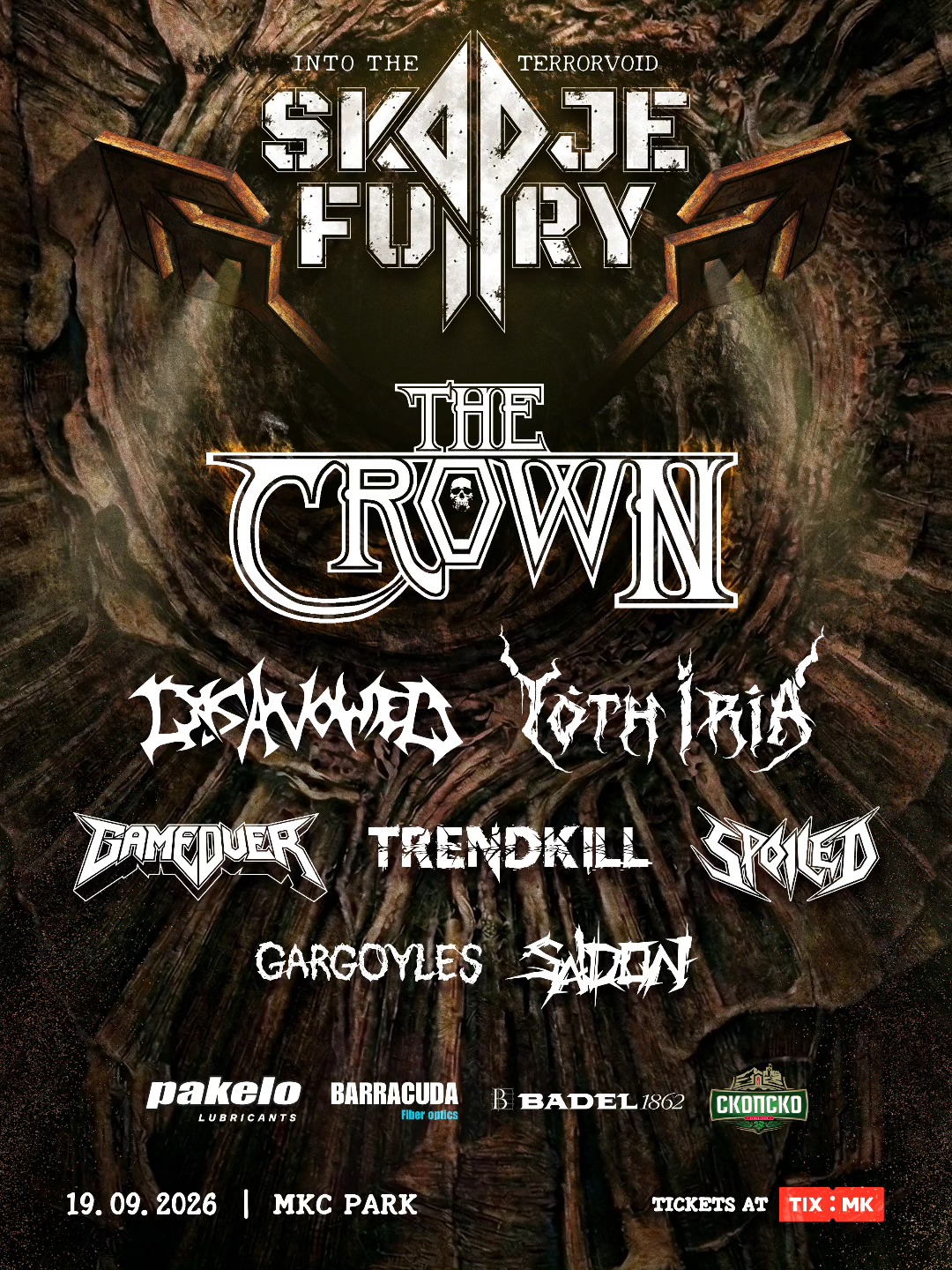
19. September 19th will be your first ever show in Skopje. How did the collaboration with Terrorvoid Promotions come about, and what made you say yes to this show?
The short answer is that we always prioritize areas and countries where we’ve never played before. We’re doing a double bill that weekend, in both Serbia and Macedonia, so for us it was a no-brainer. We always prioritize these kinds of shows. We only have a limited number of days this year when we can do these farewell shows, and we’ll always prioritize new countries. So this is our absolute last chance to say thank you and goodbye to people who maybe never had the chance to see us live before.
20. You have Disavowed and Yoth Iria with you as support. Can you tell us a little about the bands and why they fit this tour with The Crown?
Since this is new territory for us, we don’t really know the local scene that well. So we’re trusting the promoter to know what they’re doing and that Disavowed and Yoth Iria are a good fit for the package. It’s going to be exciting to both see and hear them live.
21. Are you familiar with any of the local bands playing in Skopje? Have you listened to them?
Unfortunately, I don’t really know that side of things very well. That’s why it’s going to be especially exciting to get acquainted with the local scene. It’s new territory for us, hopefully with new impressions and new experiences. And that can lead to positive things.
22. Have you visited this part of Europe before, and what are your expectations for the show and the region?
This is new territory for us. I’m pretty sure we’ve played in Slovenia, and maybe Slovakia as well, I’m not entirely sure. But this is definitely new territory for us, and that’s exactly why we’re excited about it.
23. This is actually our second interview together, the first one being in 2018. Do you have any final words for the fans in Macedonia before your first visit to Skopje?
I hope that all of you in Macedonia who have always been curious to see us live will take the time to come to the show. It would be absolutely fantastic to share this once-in-a-lifetime evening with all of you. In general, I think it’s an incredible achievement for us as a band that we have people all around the planet who actually appreciate our music. And once again, we’re entering new territory. So come down to the show, and let’s have one fucking great, brutal night together. It’s going to be an absolute pleasure.